
The Oria River lacks sufficient hydraulic capacity as it passes through the municipality of Tolosa, resulting in overflows and flooding during flood events. The areas most at risk are the Old Town and the urban center, which are affected by floods with a return period of up to 50 years.
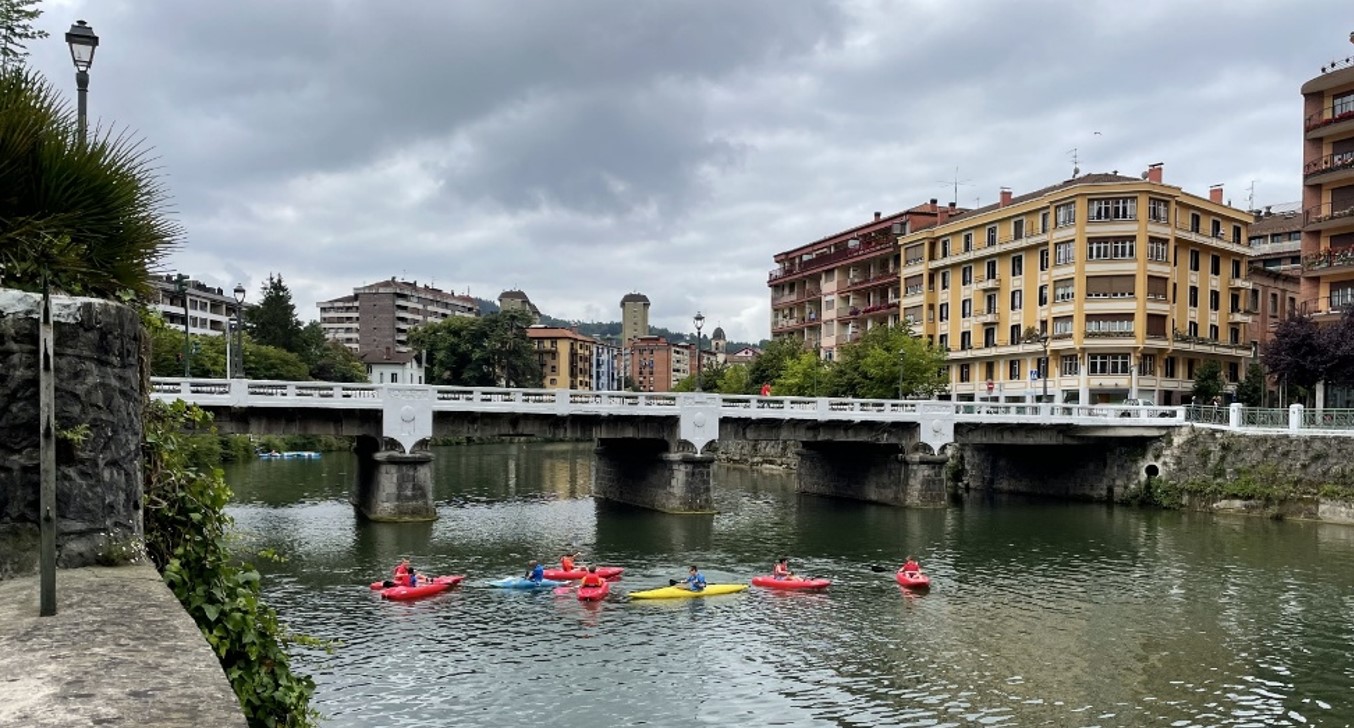
There are numerous river crossings within the municipal area, with the Oria River being spanned by a total of eight bridges: three footbridges and five road-and-pedestrian bridges. Specifically, the so-called “Puente Nuevo” (New Bridge) has been a problematic element regarding flood control, as its three piers located within the watercourse reduce the river’s hydraulic section, creating a clogging or damming effect. This structure, built in 1926 and designed by the municipal architect Guillermo Eizaguirre, was part of the Laskorain Plain Urbanization Plan, aimed at unifying both banks of the Oria.
In October 2022, a flood defense project for the Oria River in Tolosa was drafted, which included a proposal to replace the existing bridge with a single-span tied-arch solution, among other complementary measures. During the public consultation period, comments were raised regarding the landscape and urban integration of the proposed structural design; consequently, the project was not executed, and a decision was made to rethink the bridge design through a new tender process.
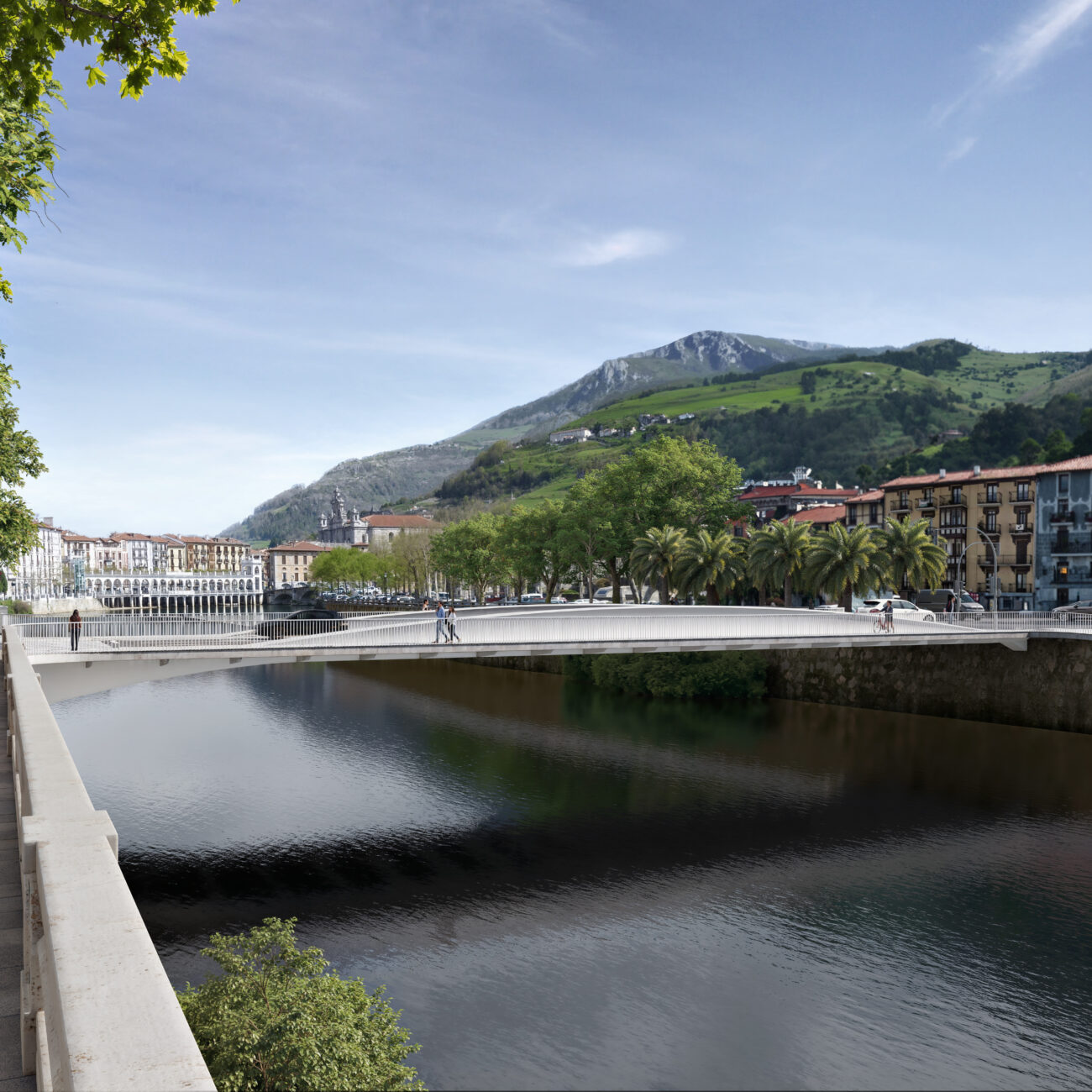
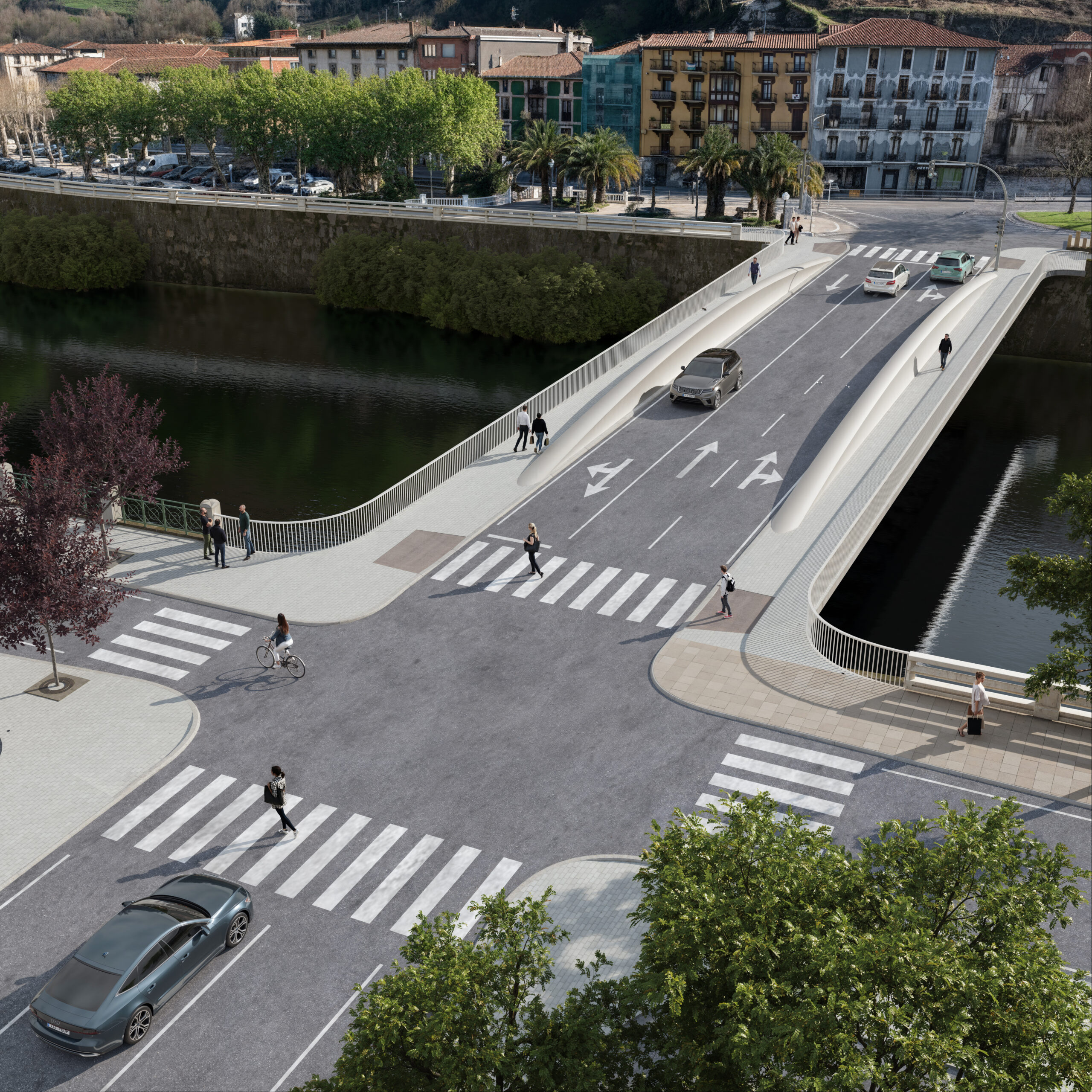
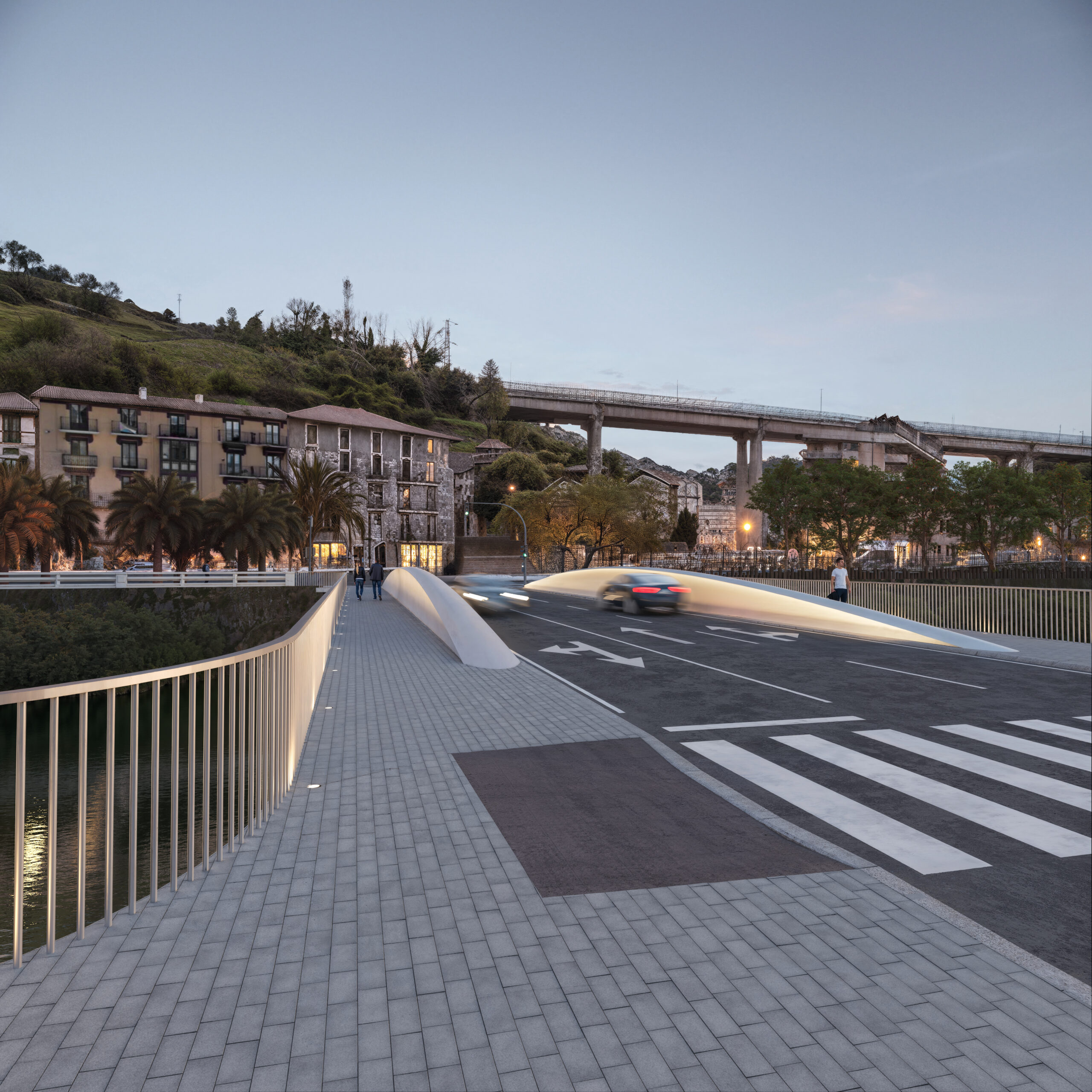
Finally, in 2024, a new competition was launched, which INES Ingenieros won. Their design features a deck supported by twin variable-depth steel girders. This solution consists of a double longitudinal girder, fixed at Abutment 1 (left bank) and supported at Abutment 2 (left bank). Its form resembles the silhouette of a fish, beginning as a fixed connection below the road level and emerging above the surface until reaching sufficient height to provide the required structural section. The initiation of the bridge on the left bank below the road level remains valid for meeting the required hydraulic criteria, while also ensuring that the curved radii of the access and exit paths—due to the intersection of the Zumalakarregi Promenade with the bridge—remain unobstructed for vehicle turning maneuvers.
On the left bank, the deck support over the existing bridge wall will be executed by installing sliding POT-type bearings. This bearing typology allows for the support of large vertical loads without transmitting horizontal stresses, for which the existing wall is not structurally designed. In this regard, because the bridge is fully fixed at the left bank, all longitudinal displacement will be accommodated on the right bank.
In elevation, the new structural proposal achieves a depth-to-span ratio of 1/22–1/24, while maintaining a maximum height of 1.50 m above the sidewalk and limiting the deck depth below the road level to 0.75 m below the road axis. The above-deck section is designed not to obstruct the user’s view, allowing pedestrians a clear line of sight toward both banks, regardless of which side of the bridge they are on. This new structural proposal succeeds in compressing the height of the 2022 solution, where the steel arch—despite being a transparent solution—reached a height of 5 meters from the underside of the deck (a height-to-span ratio of 1/11).
The cross-section of the bridge will maintain the same dimensions as the existing one, with a total width of 15 meters: two 2.40 m sidewalks and three 2.80 m intermediate lanes (two westbound, one eastbound). The longitudinal girders feature a curved cross-section between the carriageway and the top chord, with a narrowing in their mid-section. The width at the head is 0.70 m, and in the mid-section, where the curves approach each other, it is 0.50 m.
To provide the best experiences, we use technologies like cookies to store and/or access device information. Consenting to these technologies will allow us to process data such as browsing behavior or unique IDs on this site. Not consenting or withdrawing consent, may adversely affect certain features and functions.